

🧩 What is the Periodic Table?
-
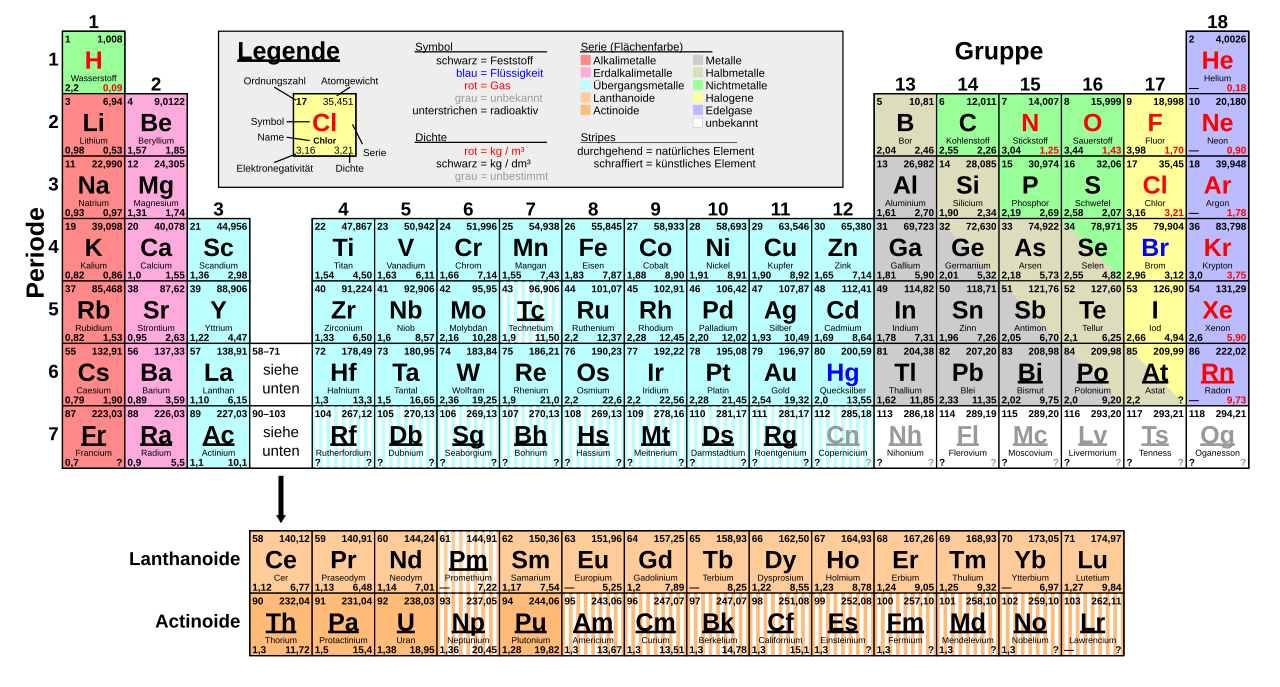
The Periodic Table is a tabular arrangement of all known chemical elements. It was developed to systematically display the properties of the elements and their relationships to each other.
-
The main idea is that elements with similar chemical properties occur at regular intervals (periods) and can be grouped together.
-
The structure helps predict the behavior of elements, understand their construction, and explain reactions more effectively.
-
Its purpose is to provide a universal reference tool for chemists.
-
⚙ introduction
📏 What is a Period?
-
A period in the Periodic Table is a horizontal row. There are seven periods in total.
-
The elements in a period have different properties, but they show a smooth transition from metallic to nonmetallic characteristics.
-
The atomic number of the elements increases from left to right.
-
With each new period, a new electron shell in the atom begins, meaning the outermost electrons occupy an additional shell.
-
This periodic progression of properties is the effect that inspired the name "Periodic Table".
-
⚙ period
🗂️ What is a Group?
-
A group is a vertical column in the Periodic Table.
-
There are 18 main groups, often identified by Roman numerals or by a key element in the group, e.g., Alkali Metals (Group 1) or Halogens (Group 17).
-
Elements in a group have similar chemical properties because they share the same number of outer electrons (valence electrons).
-
For example, all alkali metals react similarly with water.
-
The group structure helps predict properties and reaction patterns.
-
⚙ group
🔢 Atomic Number Explained
-
The atomic number (also called proton number) of an element gives the number of protons in the nucleus of its atom. It determines the identity of an element and its place in the Periodic Table.
-
All atoms of an element have the same atomic number.
-
For example, hydrogen has atomic number 1 because its nucleus contains one proton.
-
As the atomic number increases, the mass and complexity of atoms also increase.
-
⚙ atomicnumber
⚖️ Understanding Atomic Mass
-
The atomic mass of an element is the average mass of its atoms, given in atomic mass units (u or amu).
-
It results from the sum of protons and neutrons in the atomic nucleus.
-
In the Periodic Table, atomic mass is usually shown as an average of all naturally occurring isotopes of an element.
-
Atomic mass is important for calculations in chemical reactions and stoichiometric relationships in chemistry.
-
⚙ atomicmass
🔗 Connection: Structure and Chemical Properties
-
The arrangement of elements according to atomic number and electron configuration means that elements with similar properties are found in the same group. This means:
-
- Members of a group have the same number of valence electrons, so their chemical reactions are similar.
- Properties change periodically across the periods: metallic character decreases from left to right or increases from top to bottom.
- Atoms in the same group show similar bonding behavior and reactivity.
-
Group Valence Electrons Notable Property 1 (Alkali Metals) 1 Highly reactive, easily form ions 17 (Halogens) 7 Readily form salts with metals 18 (Noble Gases) 8 Very unreactive -
Thus, the Periodic Table helps us understand and predict chemical properties thanks to its systematic structure.
-
⚙ connection