

Contents Overview
-
- 🎬 Introduction: observation task before watching
- ▶️ The video in focus
- ❓ Guiding questions about the video
- 🧭 Background 1: Why Germany was divided
- 🏙️ Background 2: What the GDR means in the video
- 🧱 Background 3: Wall, escape, and division in everyday life
- 🕊️ Background 4: Peaceful Revolution and reunification
- 🧠 Quiz question 1
- 🧠 Quiz question 2
- 🧠 Quiz question 3
- 🧠 Quiz question 4
- 🧠 Quiz question 5
- 🗣️ Transfer task: Your own survey like in the video
1
🎬 Introduction: observation task before watching
-
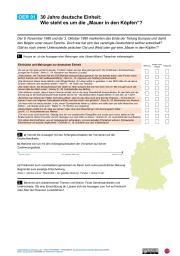
The video shows how reporter Moritz Harms interviews people in Cologne about German Unity Day. Your task: Pay attention not only to facts, but also to knowledge, uncertainties, and typical misunderstandings.
-
Observe while watching:
-
- Which answers are correct?
- Where are people unsure or confusing terms?
- Which events are mentioned?
- What role does October 3, 1990 play?
- What does the video say about how present history still is today?
-
Take notes in two columns:
-
Category Observation Correct statements What seems historically accurate in the video Uncertain statements What seems unclear, shortened, or incorrect -
Goal: You watch the video like a history detective and check what people really know about the division of Germany.
2
▶️ The video in focus
-
Bevor ihr mit den Aufgaben startet, seht euch das Video aufmerksam an. Es steht im Zentrum der ganzen Unterrichtseinheit.
- Quelle: Landeszentrale für politische Bildung Nordrhein-Westfalen, Lizenz CC BY-ND
-
-
Worauf du achten solltest:
-
- Welche Fragen stellt der Reporter?
- Welche historischen Begriffe tauchen auf?
- Welche Antworten überraschen dich?
- Was sagt das über Erinnerungskultur heute?
-
Merke: Das Video ist keine Doku mit langen Erklärungen. Es arbeitet mit Straßenumfragen. Gerade deshalb ist spannend, was Menschen spontan über DDR, Teilung, Friedliche Revolution und Wiedervereinigung wissen.

3
❓ Guiding questions about the video
-
Answer the questions directly after watching. Use specific statements from the video.
-
Guiding questions:
-
- Why were there two German states after 1945?
- What do the interviewees know about the GDR?
- Which reasons for the long division become visible in the video?
- Why was the Peaceful Revolution of 1989 important?
- Why is October 3 a public holiday?
- Which gaps in knowledge become clear in the survey?
-
Way of working:
-
- Compare your answers with a partner.
- Mark together: certain, uncertain, open.
-
Take-away: The video does not just provide answers. It also shows which questions about German unity still need to be clarified today.
-
- Source: Federal Agency for Civic Education - license CC BY-SA
4
🧭 Background 1: Why Germany was divided
-
The video asks why there were two German states in the first place. For that, you need the historical core in short form.
-
After the Second World War, Germany was occupied by the victorious powers. Different political ideas led to two states in 1949: the Federal Republic of Germany (FRG) in the West and the German Democratic Republic (GDR) in the East.
-
Short overview:
-
Aspect West East State FRG GDR Alliance more western-oriented strongly influenced by the Soviet Union Politics Democracy socialist one-party state -
Connection to the video: If interviewees are unsure why there were two German states, this basic framework helps. The division was a consequence of the Cold War, not simply a random separation.
5
🏙️ Background 2: What the GDR means in the video
-
The GDR appears in the video as an important term. It refers to the East German state from 1949 to 1990.
-
The GDR was not a democratic state like the FRG. Elections were not free, criticism was dangerous, and many people were under surveillance. At the same time, everyday life, school, work, and housing were a completely normal part of life there for many people.
-
Important features of the GDR:
-
- socialist state
- strong control by the leadership
- restricted freedom to travel
- surveillance, especially by the State Security Service
- border with the FRG, later secured with the Wall
-
Connection to the video: When people in the survey mention only fragments, this shows: Many know the term GDR, but not always the reality of life behind it.
6
🧱 Background 3: Wall, escape, and division in everyday life
-
The video indirectly reminds you that the division was not only political. It shaped the everyday lives of millions of people.
-
In 1961, the Berlin Wall was built. It was meant to prevent people from fleeing from the GDR to the West. Families were separated, travel was heavily restricted, and the border was strictly guarded.
-
Consequences of the division:
-
- separated families and friendships
- restricted freedom in the GDR
- escape attempts with high risk
- major differences between East and West
-
Connection to the video: If interviewees mention October 3 but cannot explain the Wall or the reasons for escape, this everyday connection is often exactly what is missing. The video makes visible how important such basics are for understanding unity.
7
🕊️ Background 4: Peaceful Revolution and reunification
-
The video leads to the decisive question: Why did unification finally succeed in 1990?
-
In 1989, more and more people in the GDR protested against the political system. Many demanded freedom, participation, and freedom to travel. In many places, the protests remained peaceful. That is why people speak of the Peaceful Revolution.
-
After the fall of the Berlin Wall on November 9, 1989, everything changed quickly. On October 3, 1990, the GDR joined the Federal Republic. This day is considered German Unity Day.
-
Mini timeline:
-
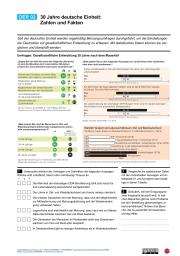
Year/Date Event 1949 Founding of the FRG and GDR 1961 Construction of the Berlin Wall 1989 Peaceful Revolution, fall of the Wall 3.10.1990 German unity -
Connection to the video: This is exactly the knowledge that is asked about or assumed in the survey.
-
- Source: Federal Agency for Civic Education - license CC BY-SA
13
🗣️ Transfer task: Your own survey like in the video
-
Now you work like the reporter in the video. Conduct a small survey in your surroundings, for example with parents, grandparents, neighbors, or other adults.
-
Your task:
-
- Interview at least 3 people.
- Ask 4 short questions about German unity.
- Write down the answers as literally as possible.
- Compare the results with the video.
-
Possible questions:
-
- Why were there two German states?
- What does the abbreviation GDR stand for?
- Why is October 3 a public holiday?
- What happened in 1989 that led to unity?
-
Evaluation:
-
Person certain answer uncertainty/error surprise 1 2 3 -
Conclusion: Write 5 sentences about what your survey shows about historical knowledge today.